For the past several years, Halifax landlords have operated in one of the tightest rental markets in Canada. Vacancy rates that hovered near 1%, rapidly rising rents, and a near-endless queue of prospective tenants made property ownership highly favorable — even for owners who hadn’t upgraded their units in years.
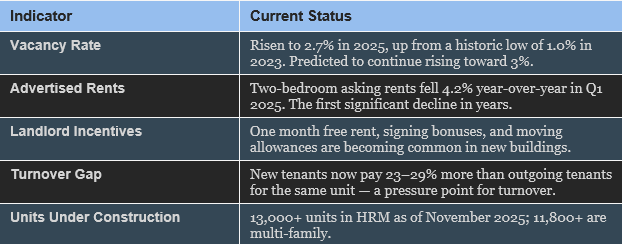
That era is ending. With over 13,000 housing units currently under construction in the Halifax Regional Municipality (HRM) — more than 11,800 of them multi-family — the rental landscape is shifting in ways that will reward proactive owners and penalize those who stand still.
This article explains what is happening, what it means for your investment, and provides concrete steps you should be considering right now.
What the Data (and CMHC) Is Telling Us
The numbers paint a clear picture of a market in transition
What This Means for You as a Property Owner
If you own a rental unit that hasn’t been significantly updated in the last five to ten years, you are now competing directly against brand-new, purpose-built rentals offering modern finishes, in-suite laundry, building amenities, and sometimes financial incentives. That’s a competition that older, unrenovated stock will increasingly lose.
The good news: vacancy rates, while rising, remain relatively healthy by national standards. You still have time to act from a position of strength rather than desperation. But that window is narrowing.
Your Decision: Reinvest, Reposition, or Exit
There is no single right answer — the best path depends on your financial position, your property’s condition, and your long-term goals. Here is how to think through each option:
Option 1: Reinvest and Compete
If your property has good bones — solid location, reasonable size, and structural integrity — targeted reinvestment can position it competitively for years to come. Focus on the upgrades that matter most to today’s renters:
• Kitchen and bathroom modernization: Updated cabinetry, countertops, and fixtures have an outsized impact on perceived value.
• In-suite laundry: This is increasingly a baseline expectation, not a premium feature.
• Energy efficiency: Heat pumps, upgraded insulation, and modern windows reduce tenant utility costs and improve comfort — a meaningful competitive differentiator.
• Curb appeal and common areas: First impressions matter when tenants have more options to choose from.
• Smart home basics: Keyless entry, reliable internet infrastructure, and modern thermostats are low-cost additions that resonate with younger renters.
The key question to ask: after reinvestment, can your unit command a rent that justifies the cost and still attracts quality tenants? If yes, invest. If the math doesn’t work, consider the next option.
Option 2: Reposition to a Niche Market
Not every property needs to compete with new luxury builds. Some older stock has genuine appeal for specific tenant profiles:
• Affordable workforce housing: New construction is predominantly high-end. Clean, well-maintained older units at accessible rents will continue to have strong demand from nurses, tradespeople, and service workers.
• Student and young professional rentals: Proximity to universities or employment hubs can command reliable demand regardless of finish quality.
• Short-term or furnished rentals: Depending on zoning and regulations, repositioning as furnished or mid-term rental accommodations can access a different and less price-sensitive market.
Option 3: Sell While the Market Remains Favorable
For some owners, this is the right time to exit. Here’s why:
• Property values remain elevated. Years of appreciation combined with strong investor demand have created significant equity for long-term owners. That equity is at risk of erosion as market conditions soften.
• Cap rates remain favorable. As vacancy rises and rental income growth slows, the income a property generates relative to its value becomes less attractive to buyers. Higher vacancy expectations will eventually pressure sale prices.
• Deferred maintenance becomes expensive. In a competitive market, cutting corners on maintenance is no longer viable. If you’ve been deferring major repairs, the cost of catching up may outweigh the returns.
• Tax and estate planning opportunities: A sale now — before any market softening — may allow for more favourable capital gains treatment or estate simplification.
Selling is not failure. For owners who have held for 10, 15, or 20+ years, this may simply be the optimal moment to crystallize gains and redeploy capital — whether into newer property, other asset classes, or retirement.
Action Steps for Property Owners: Start Now
• Get a current market assessment. Understand what comparable units in your area are renting for — and what they’re offering. Visit newly built competition in person.
• Audit your property honestly. Walk through your unit as a prospective tenant would. What would make you choose a new build instead? That list is your to-do list.
• Run the reinvestment numbers. Get quotes for meaningful upgrades and model the rent increase required to recover the cost over three to five years.
• Talk to a commercial real estate advisor about sale value. Even if you’re not selling, knowing your property’s current market value is essential to making a rational hold-or-sell decision.
• Review your financing. Interest rates remain elevated. If your mortgage is coming up for renewal, model multiple scenarios — hold, renovate, and sell — against your current and projected cash flow.
• Consider your timeline. Are you planning to hold for another 5 years? 15 years? Your decision calculus changes significantly based on your exit horizon.
The Bottom Line
Halifax’s rental market is not crashing — but it is normalizing. For years, the market was so undersupplied that ownership required little strategy beyond showing up. That is no longer true.
The owners who will thrive in the next five years are those who treat their properties as businesses: who understand their competitive position, invest deliberately, and make rational decisions about when to hold and when to sell.
The supply wave is already in the water. The question is whether you’re positioned to ride it — or get washed over.
This article is for informational purposes only and does not constitute financial, legal, or investment advice.